
Why Do I Feel So Stuck?

Updated: Jun 18
A compassionate, practical guide to understanding stuckness, change, and personal growth.

“Why do I feel so stuck? I’m going through life… but I’m not really living it.”
If that thought feels familiar, this article is for you.
Because if you’re here, reading this, chances are something feels… off.
Not dramatically wrong. Not necessarily something you can even explain clearly to someone else.
But there is a quiet sense that:
this is my life… and yet it doesn’t feel like the life I want to be living.
As a South African Life Coaching Practitioner, this is one of the most common reasons people come to coaching.
They don’t always come with a clear goal.
They come with a feeling:
“I feel stuck.”
“I don’t know what I want anymore.”
“I should be grateful… but I’m not happy.”
And I understand that deeply—because I have lived it too.
My own experience with asking myself "why do I feel so stuck?"
Seven years ago, I found myself in a period of life where nothing I did seemed to move me forward in any meaningful way.
In a very short space of time:
I lost both my parents
My brother and his family emigrated
I went through a divorce
Work was demanding and, at times, overwhelming
And the world itself felt heavy and uncertain as we moved through Covid 19.
Usually, in difficult times, there is some sense that things will get better.
At that time, it didn’t feel like that at all.
It felt like everything—personally, professionally, emotionally—was shifting at once.
And underneath all of that was a quiet, persistent feeling:
I am living my life… but I don’t feel connected to it.
It wasn’t dramatic. It wasn’t chaotic. It was something subtler—and in many ways more disorienting: A loss of direction. A loss of clarity. A loss of self.
What does “feeling stuck” actually mean?
Feeling stuck is often misunderstood.
It’s not laziness. It’s not lack of discipline. And it’s not a personality flaw. More often than not, it’s a signal. A signal that something in your life is no longer aligned.
That misalignment can show up as:
Low motivation
Indecision
Overthinking
Procrastination
Staying busy but not actually moving forward
It can also show up emotionally as:
Restlessness
Disconnection
Quiet dissatisfaction
A longing for something you can’t quite define
For many people, this is brushed off as “just a phase.”
But when that phase stretches into months—or years—it becomes something else entirely.
It becomes exhausting.
Why we stay stuck
One of the most important things to understand is this: Your brain is not designed for growth—it is designed for safety.
Even when you consciously want change, your mind will often default to what is familiar. Even if that familiar place is uncomfortable.
That is why people get stuck in loops:
Thinking instead of acting
Avoiding decisions
Adding pressure
Trying to “push through”
But pushing through rarely works. Because stuckness is not something to override.
It is something to understand.
“Your brain prefers familiar discomfort to uncertain growth. That doesn’t mean you’re broken—it means you’re human.”
The “dark night of the soul”: when everything feels uncertain
Across different traditions, this experience of feeling lost has been recognised as part of the human journey.
In spirituality, it is often referred to as the “dark night of the soul.”
A period where:
Meaning feels unclear
Direction disappears
Identity begins to unravel
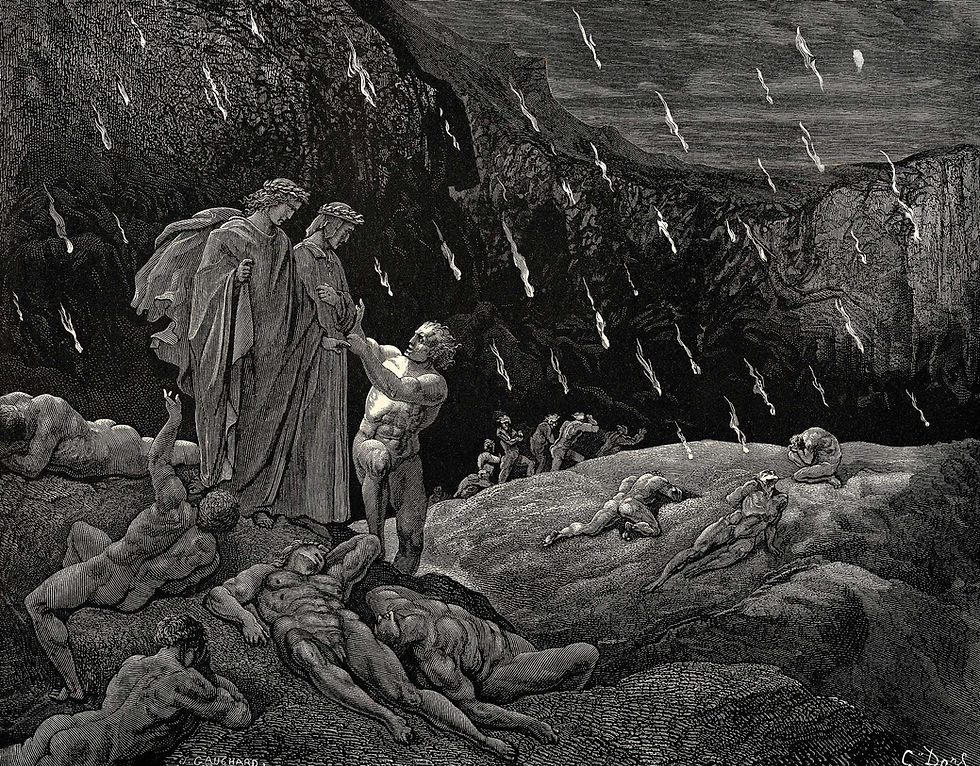
In literature, one of the most powerful depictions of this comes from Dante’s Inferno.
His story begins with a man in midlife who finds himself lost in a dark forest, having wandered from the right path.
It’s a striking image—but it resonates because it is so human.
Dante isn’t just physically lost. He is psychologically and spiritually disoriented. And importantly—his journey doesn’t begin by moving forward.
It begins by descending.
He has to move through confusion, discomfort, and difficulty before he can find clarity again.
This is something we don’t often talk about.
We want growth to feel uplifting.
We want change to feel motivating.
But in reality: Growth often begins in uncertainty.
The Hero’s Journey: you are not the exception
Joseph Campbell described something called the Hero’s Journey—a pattern that appears across stories, cultures, and human lives.
It follows a simple arc:
The ordinary life
A disruption or call to change
A descent into challenge or uncertainty
Transformation
A return, changed
This is not just a storytelling framework.
It is a psychological one.
And if you look closely:
Feeling stuck is often the call to the journey.
It is the moment where your current way of living is no longer working…but your next way of living hasn’t yet formed.
That space in between?
That’s where most people start to panic. Because it feels like nothing is happening.

The change cycle: why stuckness is often the beginning
This is where Martha Beck’s Change Cycle becomes incredibly helpful.
It explains that transformation doesn’t happen in a straight line.
It happens in phases:
Dissolution (Death & Rebirth) – your old life stops working
Dreaming – new ideas begin to form
Action – you start experimenting with change
Integration – your new identity stabilises
That feeling of being stuck?
It lives in the first phase.
The phase where:
The old identity is dissolving
The old structure no longer fits
But the new one hasn’t yet taken shape
This phase can feel like:
Confusion
Lack of progress
Emotional fatigue
Being “in limbo”
When I was in that period of my life, it felt like nothing was happening.
Looking back now, I can see something very different.
Everything was changing—just not externally yet.

Navigating stuckness is a life skill
This is one of the most important things I now teach through my work as a Life Coach:
Being stuck is not the problem.
Not knowing how to move through it—that’s the problem.
Most of us were never taught this.
We were taught to:
Have answers
Be productive
Keep moving
But real growth doesn’t work like that.
Sometimes it looks like:
Pausing
Questioning
Sitting with uncertainty
Letting something fall away before replacing it
This can feel uncomfortable—even scary.
But it is also where the most meaningful change happens.
What to do when you feel stuck
Instead of trying to force your way out of it:
Acknowledge where you are
Get curious instead of critical
Take small, meaningful steps
Allow clarity to emerge rather than forcing it
Seek support
Because navigating change is significantly easier when you are not doing it alone.

How coaching helps
When people come to coaching, they often think they need answers.
What they actually need is something different.
They need:
Space to slow down
Structured reflection
Honest conversation
Support that helps them see clearly
Through Online Life Coaching in South Africa, I support clients through exactly this phase.
Not by telling them what to do…but by helping them understand what is really happening.
From there, everything begins to shift.
Clients start to:
Understand their patterns
Build self-awareness
Make clearer decisions
Take aligned action
And most importantly:
They don’t just get unstuck once. They learn how to move through stuckness for the rest of their lives.
Ready to move forward?
If you are in a season where things feel uncertain, you do not need to have every answer.
You don’t need a full plan.
You simply need the willingness to take the next honest step.
Whether you’re looking for a Life Coach Johannesburg, Life Coach Pretoria, or support through Online Life Coaching South Africa — Change is possible.
Final thought
Feeling stuck is not the end of your story.
More often than not — it is the beginning of it.
Because when you go through deep and fundamental change: You do change.
But you also return. To yourself. To your truth. To the part of you that has always been there underneath it all.
And the skillset you build in that process becomes something powerful:
A quiet confidence.
That you can navigate uncertainty, fear, and change — Because you already have.


Comments